
By Emma Gilpin | Reach Liaison Nurse
When we started the Reach Liaison Nurse pilot, we already knew from families that those first conversations following the identification of an upper limb difference can stay with you forever.
Families remember the words that were used. They remember the information they were given – and sometimes the information they weren’t given. They remember how that conversation made them feel at a time when they were trying to understand something completely unexpected about their baby.
But what does that experience look like from the other side of the conversation?
What education have healthcare professionals received? How confident do they feel supporting families? Do they know where to find reliable information? Is there a clear pathway to follow? And importantly, do they know that Reach is here?
Those were some of the questions I really wanted the Reach Liaison Nurse pilot to explore.
Building a national picture
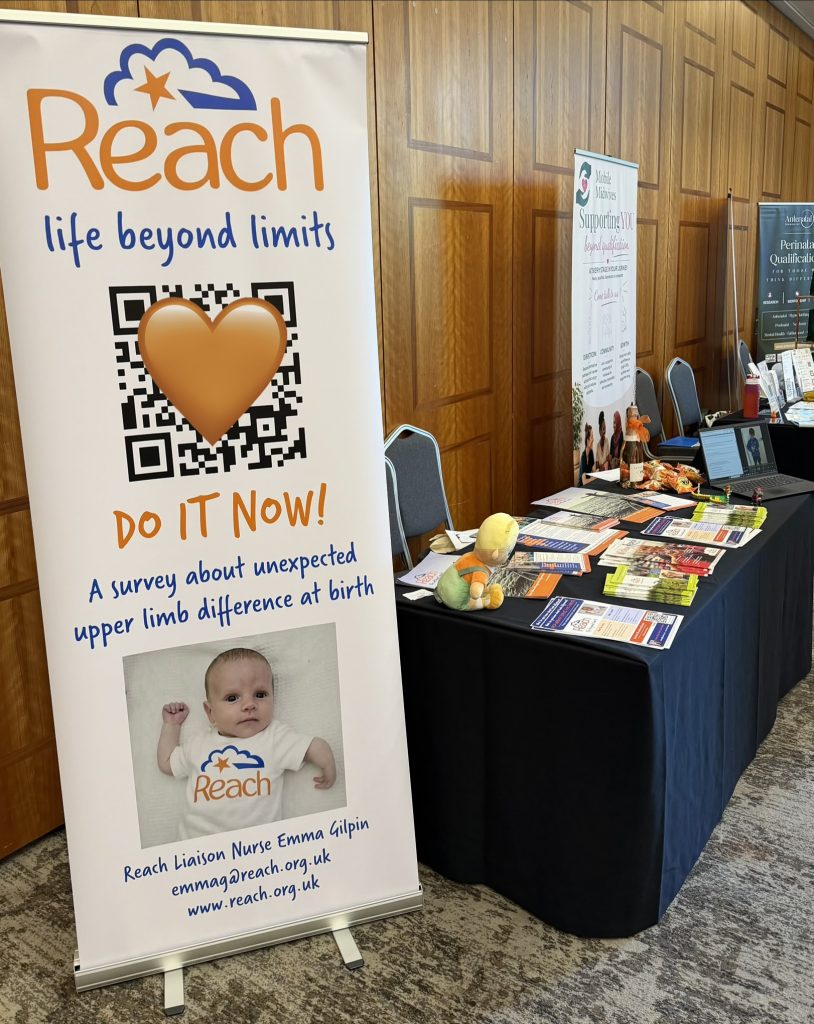
Over the past year, we’ve been asking healthcare professionals from across the UK to take part in our national survey looking at current practice when a baby is identified with an unexpected upper limb difference.
The findings so far are really interesting and are beginning to build a much clearer picture of what is happening nationally.
We’re seeing significant variation in the education, training and support healthcare professionals have received around upper limb difference and delivering unexpected news to families.
Many professionals have told us they have had little or no formal education specifically about upper limb difference, and confidence in supporting families varies considerably.
We’re also seeing inconsistencies in referral pathways, the information and resources available to professionals, and awareness of organisations such as Reach.
The survey is still ongoing and the full findings haven’t yet been published, so I’m not going to give all the results away just yet!
But there is one message coming through particularly strongly:
Healthcare professionals want to get this right.
People want to learn
This has probably been one of the most encouraging things I’ve discovered through the project.
I’ve spent the past year talking to midwives, neonatal nurses, NIPE practitioners, paediatric professionals, students and many others who may find themselves supporting a family when an upper limb difference is first identified.
Again and again, people have told me that they want more knowledge and education.
They want to know what to say.
They want to understand the language families prefer.
They want reliable resources they can actually use.
They want to know where families can find support.
And they want to feel more confident having a conversation that, for them, may be relatively rare; but for the family in front of them is enormous.
That distinction is really important.
A healthcare professional may only have this conversation once or twice during their career. For a parent, it is the conversation about their baby, and they may remember it for the rest of their life.
How can we expect professionals to feel completely confident if we’ve never given them the education, resources or opportunity to prepare for it?
This isn’t about pointing fingers or saying that healthcare professionals are getting it wrong.
It’s about recognising a gap, and doing something useful about it.
From survey responses to real conversations
Something else has happened through the survey that I hadn’t fully anticipated.
It hasn’t just generated data. It has started conversations.
Healthcare professionals have made contact because they want further information. Some have asked to stay connected with Reach. Others are interested in education or in sharing the project with their teams and colleagues.
Alongside the survey, I’ve been able to speak directly with professionals at maternity events, teaching sessions and through professional networks, and those conversations are helping us understand the story behind the survey responses.
What do professionals actually need?
What would make a difference in practice?
What information would be useful when they are standing beside a family?
And how do we make sure that families aren’t simply handed information and left to navigate everything themselves?
For me, this is where the project starts to become really exciting.
We’re not just identifying a gap anymore.
People are asking us to help fill it.
Why does the first conversation matter so much?
Because you don’t get another go at it.
When an upper limb difference is first identified, parents can suddenly find themselves trying to imagine an entire future for their child based on very little information.
The words used at that point matter.
Families need honesty, but they also need balance.
They need to know that their child may do some things differently, but different doesn’t automatically mean unable.
They need good, reliable information rather than having to go home and disappear down an internet rabbit hole.
And they need to know that there are children, young people and adults with upper limb differences out there living full, busy and wonderfully ordinary lives.
Sometimes simply seeing another child with a similar difference or speaking to another parent who gets it can completely change the picture.
That’s where Reach can make such a difference.
So, what are we learning?
We’re still gathering the evidence and there is much more work to do before we share the full survey findings.
But already, the picture is becoming clearer.
There are gaps in education and confidence. There is variation in pathways and resources. Awareness of the support available to families isn’t consistent.
But there is also a real appetite to make things better.
Healthcare professionals are engaging with us. They’re asking questions. They’re requesting education. They’re sharing the survey and introducing Reach to colleagues.
For me, that’s a hugely positive finding in itself.
The Reach Liaison Nurse pilot started with a fairly simple question: could we make those first experiences better for families?
What I’m learning is that supporting families also means supporting the healthcare professionals standing beside them.
Give professionals the knowledge, language, resources and connections they need, and we have the potential to influence far more families than one Liaison Nurse could ever reach alone.
Because the first conversation really does matter – and together, we can make it a better one.